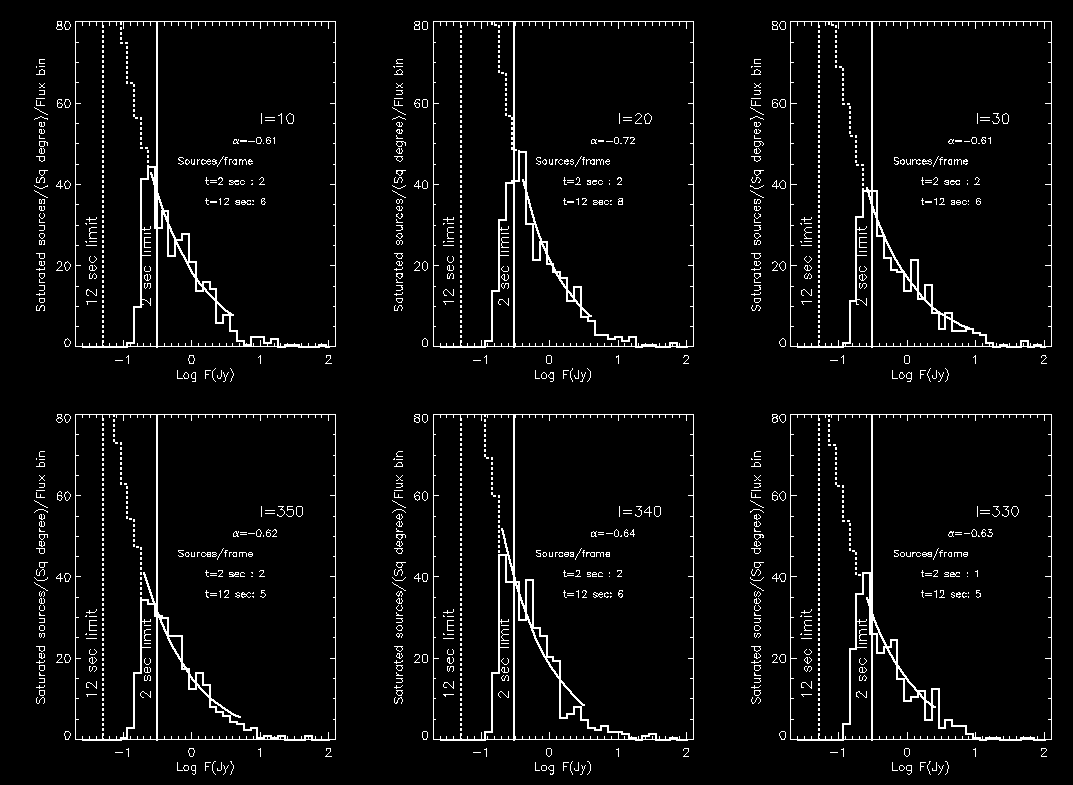
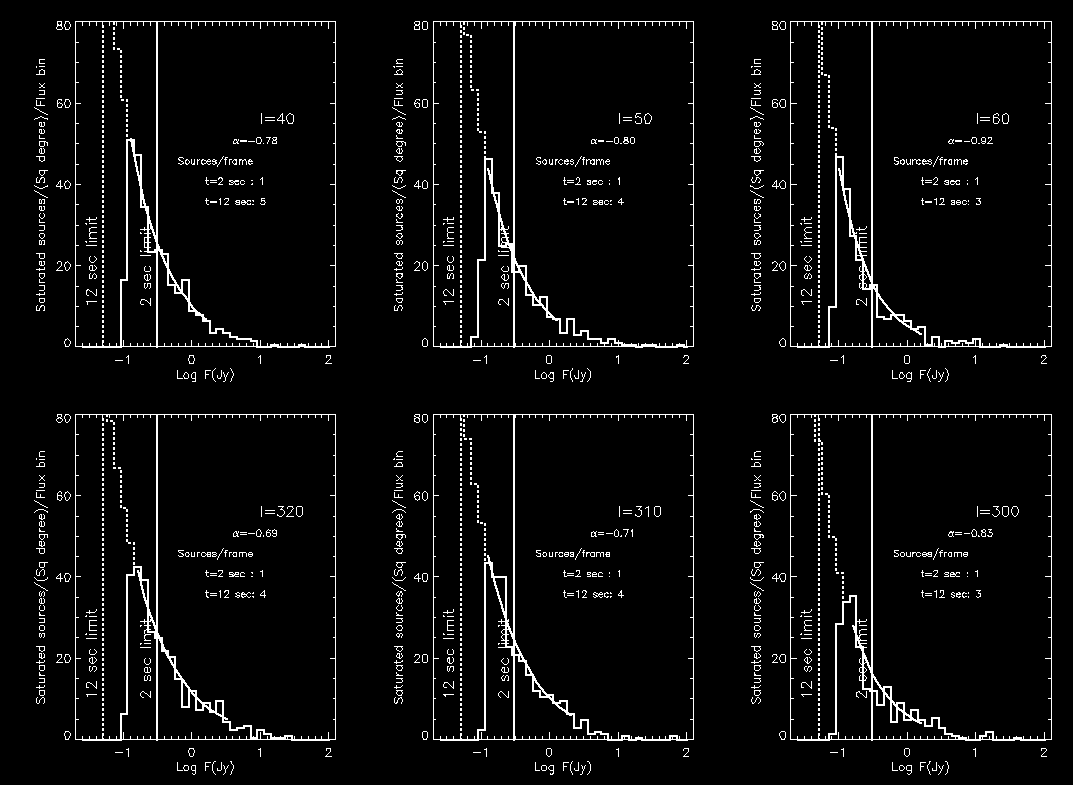
Histograms of number of point sources per square degree per flux bin (averaged over the rectangle b=+/-0.5 degrees, l= l+/1 degree) using the MSX point source catalog. The solid vertical lines show the saturation limit for an exposure time of 2 seconds. All sources in the bins to the right of the line will saturate. The dotted line vertical line shows the limit for an exposure time of 12 seconds. We have extrapolated the MSX point source histogram to faint sources using a powerlaw fit. This fit is shown, and the power law index is given.
NOTE: IRAC is 5.12' x 5.12', or an area of 7.282 x 10⁻³ square degrees.
NOTE2: Used 300 milliJy as the saturation limit.
Take the point source saturation for 2 second limit from IRAC manual
Point source will saturate in the 2 second integration...
           3.6 um  4.5 um  5.8 um  8.0 um
 0.4 sec    2920    2540    6500    3560
 2 sec       365     318     813     444
 12 sec       66      58     148      80
   (saturation for point sources in milliJy)
   Use POINT_SRC_SAT=300 milliJy as mininum number...
NOTE3: For diffuse saturation, did the following300 mJy x (0.5) / (1.2x1.2) / 2.35e-11 /1e9=4438 MJy/sr (pt source limit) x (flux in central pixel) /(area of pixel-arsec)/(convert to sr)/(convert to MJy) Use conversion factor 7.133e6 to convert from MJy/sr to W/m^2/sr (assumes spectral energy distribution). Diffuse saturation limit=3.11e-4 W/m^2/sr
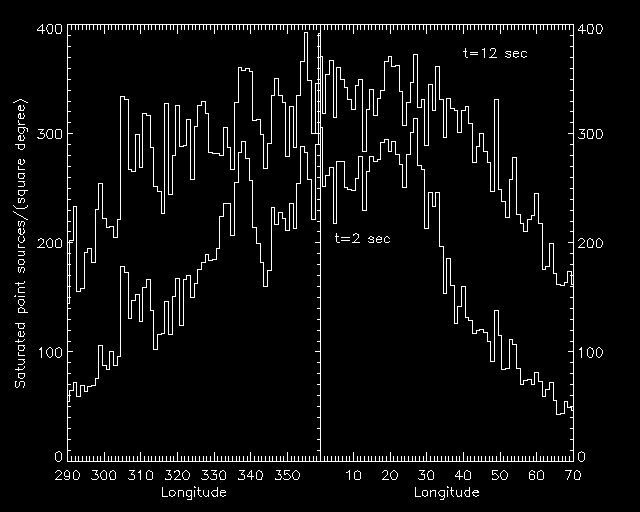
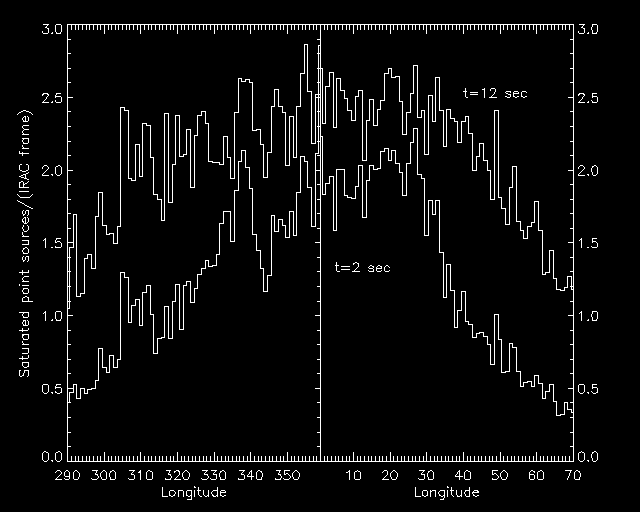
The following shows the number of MSX point sources that would saturate
the IRAC camera. One has it normalized to sources per square degree; the
other is sources per frame. The number is determined by averaging over
a 1 deg^2 rectangle.
Note. The survey area was also divided into IRAC frames and we found
how many saturated MSX sources were in each frame (to make sure things
weren't too crowded in the mid-plane). The maximum number of sources
in any tile was only *six*.