SIRTF IRAC Test Data
(last updated March 30, 2001)
Our understanding of the SSC IRAC pipeline products was mainly taken from
the IRAC Pipeline Requirements Document v1.0
(Feb 24, 2001) and the
SPIE paper by Hora et al.,
"Calibration and Performance of IRAC".
As our knowledge
increases, we will refine our test data.
We assume one channel's worth of data per exposure (excluding the raw & intermediate calibration
files) are the following:
1) a calibrated image file (which includes cosmic rays, bad pixels, saturated
pixels and banding effects)
2) photometric error image
3) bad pixel mask
4) data quality mask
5) ghost image (crosstalk between channels 3 & 4)
6) cosmic ray mask
7) latent image
8) latent image mask
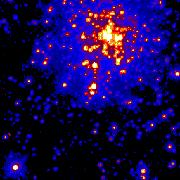
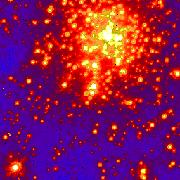
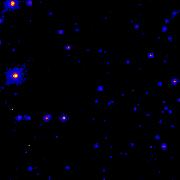
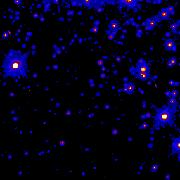
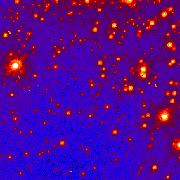
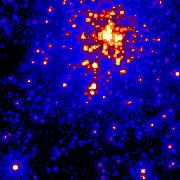
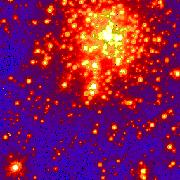
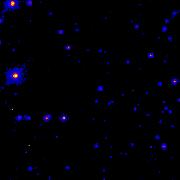
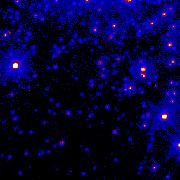
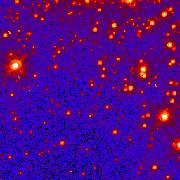
An HST WFPC2 PC1 image of R136 (along with its corresponding mask file) was used as the
starting point for our test data. It is 800 x 800 pixels. We took a couple
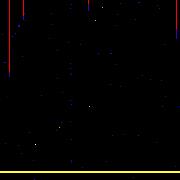
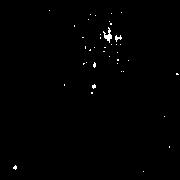
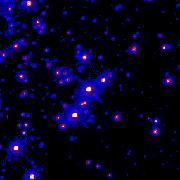
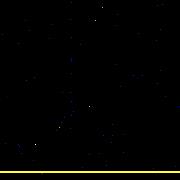
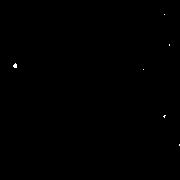
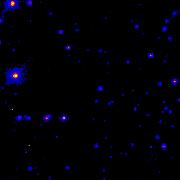
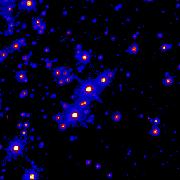
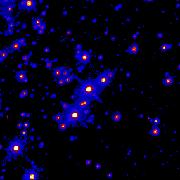
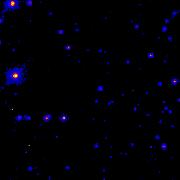
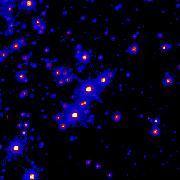
of 256 x 256 pixel sections from this image to create our 4 channels worth of IRAC data.
Noise was added to the channel 3 & 4 images.
Note that IRAC channels 1 & 3 view the same field & channels 2 & 4 the same field,
offset 1.5 arcmin from the first field. Click on the picture or title to
get more information about how these test images were created from the WFPC2 data.
For the test data of the revisit of this field, we shifted and rotated
another WFPC2 image and mask
of the same field & same exposure time. See revisit .
Still to be done is to populate the FITS header with appropriate keywords.
Currently we only have the minimum FITS headers. We also need to create an
AOR's worth of data, say 2 exposures across by 10 exposures down.
Visit 1, Channel 1 Data (3.6 microns)
Visit 1, Channel 2 Data (4.5 microns)
Visit 1, Channel 3 Data (5.8 microns)
Visit 1, Channel 4 Data (8.0 microns)